

You're driving home through Clearwater, still shaken after a crash at an intersection, or you're sitting in pain after slipping in a grocery store aisle. The first hours after an accident feel chaotic. You're worried about your injuries, your car, your job, and how the bills will get paid.
Then the legal question shows up fast. Was this just an accident, or did someone fail to act the way they were supposed to? That question sits at the heart of most Florida injury claims. In legal terms, that's often where breach of duty comes in.
If your accident damaged your vehicle, you may also run into issues beyond repair costs, including reduced resale value. A practical overview of that issue appears in this Auto Appraisal Expert guide. And if your immediate concern is how your own insurance works after a crash, Florida's Personal Injury Protection coverage is another important starting point.
Understanding Your Rights After a Florida Accident
A lot of people in Pinellas and Hillsborough County call an accident “just bad luck” at first. That's understandable. If you're rear-ended on U.S. 19, hit by a turning driver near a busy Tampa Bay intersection, or hurt by a fall in a Clearwater store, you usually don't know yet whether the law sees that event as negligence.
What changes the picture is whether another person or business had a legal responsibility to act carefully, then failed to do it. That failure is often the difference between a painful event and a valid injury claim. If someone breached a duty they owed you, Florida law may allow you to pursue compensation.
Practical rule: A claim doesn't begin with “I got hurt.” It begins with “Someone had a responsibility, and they didn't meet it.”
Personal injury cases require more than sympathy; they demand proof. The accident must be connected to a careless act, a missed precaution, or an unsafe condition that should have been addressed.
For many injured people, learning what is breach of duty brings the first real clarity. It gives a name to what felt unfair from the start. The driver who looked at a phone instead of the road. The store that left a slippery floor unmarked. The company that sold a product that shouldn't have been sold in that condition.
Once you understand that concept, the rest of the claim starts to make more sense.
Breach of Duty Explained in Plain English
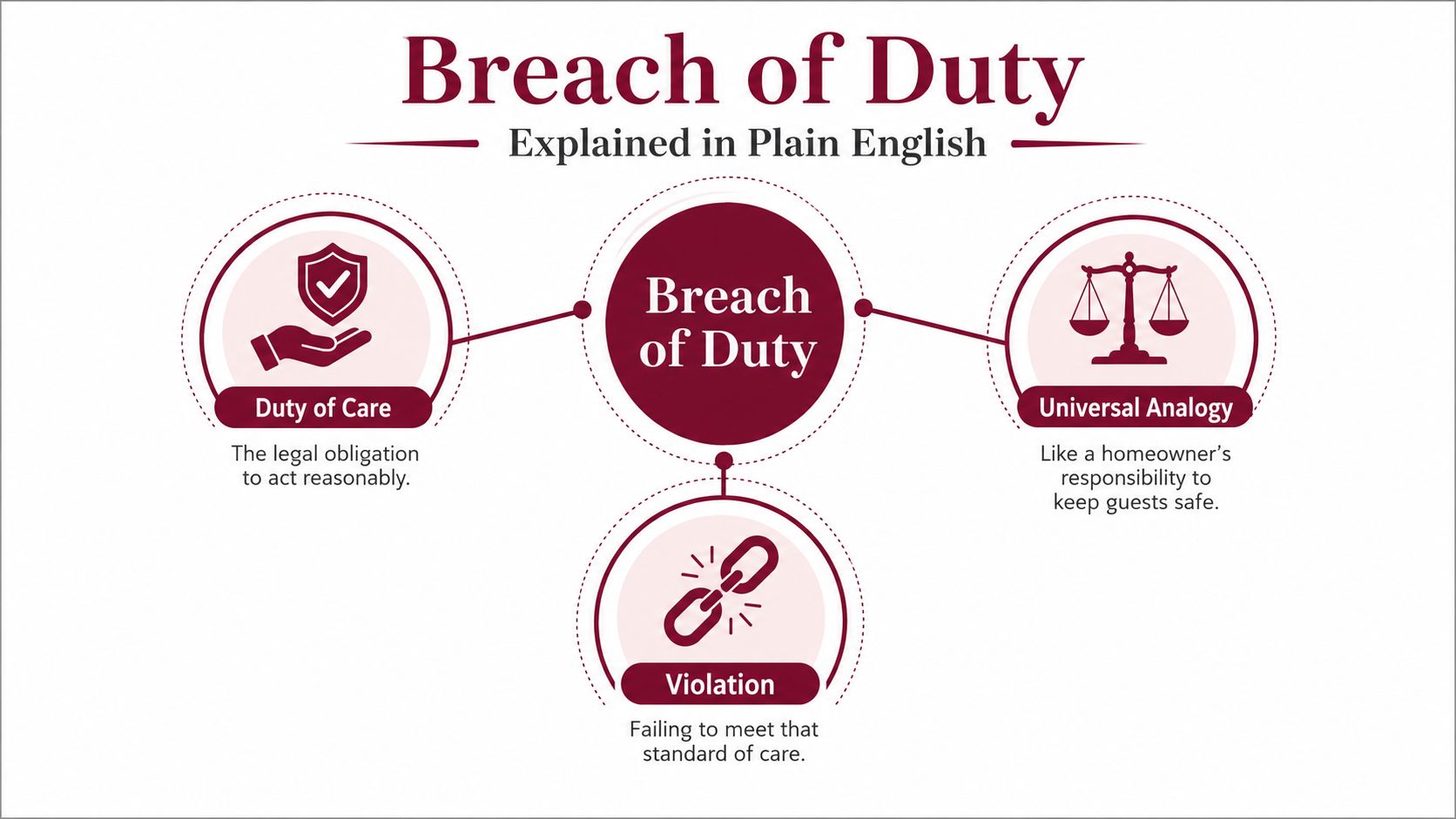
Start with the basic idea of a duty of care. In everyday terms, it means a person has a legal obligation to act with reasonable care so they don't harm others. Drivers owe that duty to other people on the road. Property owners owe it to lawful visitors. Businesses owe it when they create or control conditions that can hurt customers.
Now take the next step. Breach of duty happens when that person or business fails to meet that responsibility.
The reasonable person standard
Florida negligence law uses a common-sense benchmark. Courts look at whether the defendant acted like a reasonably prudent person would have acted under the same or similar circumstances. That's not about perfection. It's about ordinary care.
If a careful driver would stop at a red light, but the other driver doesn't, that can be a breach. If a careful store manager would clean up a spill or warn customers, but the store leaves the danger in place, that can be a breach too.
Florida lawyers often explain this to clients with a simple comparison. Think about inviting a friend into your home. You don't have to guarantee nothing bad will ever happen, but you do have to fix or warn about a hazard you know about, like a slippery floor or broken step. The law applies that same basic logic in many accident cases.
A breach can be an act or a failure to act
A lot of people assume negligence only means doing something reckless. Sometimes that's true. Speeding, texting while driving, or running a stop sign are active choices.
But a breach can also happen through inaction. Expert legal analysis explains that breach of duty includes acts or omissions, meaning the defendant either did something a reasonable person would not do or failed to do something a reasonable person would do, creating a deviation from reasonable behavior, as discussed in this legal explanation of breach of duty.
That distinction matters in real cases.
- An act could be a driver weaving through traffic.
- An omission could be a business failing to put out a warning sign after mopping.
- A professional lapse could involve conduct that falls below the skill expected from someone in that field.
If you're trying to evaluate your situation before speaking with counsel, these questions to ask a Clearwater injury lawyer can help you focus on whether someone's conduct crossed that legal line.
Breach of Duty's Role in a Florida Negligence Claim
Breach of duty is important, but it doesn't stand alone. In a Florida negligence case, it's part of a larger framework. You have to prove each required piece of the claim.

The four elements Florida requires
Florida negligence claims rest on four connected elements. According to Florida negligence law guidance, a plaintiff must prove duty of care, breach of that duty, legal causation, and actual damages, and whether the defendant acted as a “reasonably prudent person” would under similar circumstances is a question of fact for the jury.
Here's what that means in plain language:
Duty
The other person or business had a legal obligation to act carefully toward you.Breach
They failed to meet that obligation.Causation
Their failure led to your injury.Damages
You suffered real harm, such as physical injury, medical expense, lost income, or other losses.
Why breach is the turning point
A lot of potential clients understand they're hurt and know they have damages. What they often don't realize is that damages alone don't prove a claim. The law still asks what the defendant did wrong.
That's why breach is such a critical step. It connects the duty someone owed you to the injury that followed. If there's no proof the defendant failed to act reasonably, the case usually stops there, even if you were seriously injured.
The law doesn't impose liability just because an accident happened. It imposes liability when someone's conduct fell below the required standard of care and that failure caused harm.
That's also why insurance companies fight hard on this issue. They may admit an event happened but deny that their insured acted unreasonably. They may argue your injuries came from something else. They may say the situation was unavoidable.
Florida's fault rules add another layer. If you want a better sense of how shared fault can affect an injury case, Florida's pure comparative negligence overview is useful background when evaluating how liability arguments can shape recovery.
Common Examples of Breached Duties in Florida Accidents
The easiest way to understand breach is to see how it looks in everyday life. In the Tampa Bay area, certain patterns come up again and again.
Car crashes on busy Florida roads
A driver heads through a crowded intersection near Clearwater while checking a phone instead of watching traffic. Another motorist lawfully enters on a green light. The distracted driver doesn't brake in time and causes a collision.
The duty is straightforward. Every driver must operate a vehicle with reasonable care. The breach is the distracted driving. The harm that follows, such as neck injuries, back pain, or a totaled vehicle, is a foreseeable result of that careless choice.
This kind of case often turns on details. Was the driver speeding? Looking down? Ignoring a traffic signal? Small facts can decide whether the conduct qualifies as a breach.
Slip and fall incidents in stores and businesses
Now consider a Clearwater supermarket. An employee mops part of an aisle and walks away without drying it, blocking it off, or placing a warning sign. A customer turns the corner, steps on the wet surface, and falls hard.
That business owes customers a duty to maintain reasonably safe premises or warn of known dangers. The breach isn't that the floor was cleaned. The breach is leaving a hidden hazard where customers are expected to walk.
For people hurt in these situations, the legal issue often becomes whether the store knew or should have known about the danger and whether it acted reasonably in response. If your injury happened on unsafe property, these Florida premises liability attorneys resources explain how property-based negligence claims are analyzed.
Unsafe products sold to Florida consumers
A local buyer purchases a new electric scooter. On a routine ride, the brakes fail during normal use, causing a violent fall. Product-related cases can involve different legal theories, but the basic breach concept still helps people understand what went wrong.
A manufacturer or seller may have a duty to provide a product that is reasonably safe for intended use or to warn about known risks. If the scooter left the stream of commerce with a dangerous defect, that may reflect a failure to meet that duty.
What these examples have in common
Each situation involves the same core pattern:
- A duty existed because of the relationship between the parties.
- A specific act or omission fell below reasonable care.
- The resulting injury made sense as a foreseeable consequence of that failure.
Once people see that pattern, the phrase what is breach of duty becomes a lot less abstract. It becomes the answer to a practical question. What exactly did the other side do, or fail to do, that made this accident happen?
How to Prove a Breach of Duty Occurred
Saying someone was careless isn't enough. In a Florida injury claim, breach has to be proven with evidence.

What courts look at
The plaintiff carries the burden of proof. According to Forbes Advisor's discussion of breach of duty, the plaintiff must prove the breach on the balance of probabilities, meaning it is more likely than not that the defendant failed to meet the required standard of care. Courts may examine video footage, incident reports, maintenance records, and expert testimony when deciding whether the conduct was unreasonable.
That tells you something important. Cases are rarely won by broad accusations. They're built from records, visuals, statements, and analysis.
Evidence that often matters most
Some proof is immediate and simple. Some takes work to obtain.
Photos from the scene
A picture of broken glass in a walkway, skid marks in an intersection, or the lack of a warning sign can preserve conditions that disappear quickly.Video footage
Dashcams, store surveillance, and nearby security systems often show timing, movement, and whether someone had a chance to avoid the danger.Incident and crash reports
These reports can identify parties, witnesses, location details, and early descriptions of what happened.Maintenance records
In a premises case, records may show whether a business inspected the area, cleaned it properly, or ignored a recurring hazard.Witness statements
Neutral bystanders can help confirm that a driver was distracted or that a spill sat unattended.Expert testimony
In more technical cases, experts help explain why conduct fell below the proper standard.
Evidence tip: The best proof is usually gathered early, before a scene changes, footage is erased, or memories fade.
Medical records matter too, especially when they connect the accident to your injury. If you're trying to make sense of your records, this plain-language guide to interpreting your health information can help you better understand the terminology you may see after treatment. In cases involving medical standards, causation disputes, or specialized injury issues, medical expert witness testimony can also become central to proving what happened and why it matters legally.
Understanding Defenses and Florida's Fault Rules
Even when a breach seems obvious to you, the other side usually won't agree. Defendants and insurers look for ways to argue that no legal breach occurred, or that your own actions played a role.
One common defense is that the defendant acted reasonably under the circumstances. In a slip-and-fall case, a business may argue the condition appeared moments before the fall and there wasn't enough time to fix it. In a premises case, they may also claim the danger was open and obvious, meaning a reasonable person should have seen and avoided it.
Another defense targets causation rather than breach. The other side may say your injury came from a prior condition, a later event, or something unrelated to the incident itself. That's why detailed records and clear timelines matter so much.
How shared fault can affect your case
Florida fault issues can complicate a claim even if the defendant was careless. The defense may argue that you were distracted, ignored a warning, followed too closely, or failed to use reasonable care for your own safety.
That doesn't always erase a claim, but it can reduce the value of recovery depending on how fault is assigned. This is one reason accident cases can feel frustrating to injured people. You may know someone else caused the event, yet still face arguments that shift part of the blame onto you.
A strong claim doesn't just show what the other side did wrong. It also anticipates what they'll say about your conduct.
If your case involves a crash, it also helps to understand the broader insurance framework that applies across jurisdictions. This summary of state auto insurance rules gives useful background on how insurance requirements differ and why Florida claims can develop differently from claims in other states.
Steps to Take After an Injury Caused by Negligence
After an accident, the right steps protect both your health and your case. Waiting usually helps the insurance company more than it helps you.
Start with medical care. Get evaluated promptly, follow recommendations, and keep records of every appointment, prescription, and out-of-pocket cost. If you delay treatment, the other side may argue your injury wasn't serious or wasn't caused by the accident.
Then preserve what you can. Save photos, damaged property, receipts, names of witnesses, and any messages or communications connected to the event. Don't assume the police report or business incident report tells the whole story.
It's also smart to be careful with insurance adjusters. They may sound helpful, but their job is to evaluate and limit the claim. A recorded statement given too early can create problems later.
Finally, talk with a Florida personal injury attorney before key evidence disappears or fault arguments harden. When a breach of duty is proven, the defendant can be held liable for damages that include economic losses such as medical bills and lost wages, along with non-economic damages such as pain and suffering, as explained in this discussion of breach-of-duty remedies.
The legal system can compensate harm, but only if the case is built carefully from the start.
If you were injured in Clearwater, Tampa Bay, or the surrounding area and think someone else's carelessness caused it, Haddad & Associates P.A. can help you understand your rights under Florida law. The firm offers free consultations, gives clients direct access to their attorney, and focuses on the practical steps that matter after an accident, including preserving evidence, arranging care, and dealing with the insurance company.