
After a serious Florida crash, the legal question usually sounds simple. Who caused it, and who pays?
Then the actual facts show up. One driver says the other cut them off. A commercial vehicle may be involved. One insurer points at another. Meanwhile, you're trying to get medical treatment, miss work, and figure out how the bills will be paid. If more than one person or company may have contributed to the same injury, the answer gets complicated fast.
That's where people start asking about joint and several liability. They want to know whether they can recover all their damages from one responsible party, or whether they have to chase multiple defendants for separate shares. In Florida, that question matters because the rule people often hear about from older articles or out-of-state examples is not the same as the rule that usually applies here now.
A Multi-Car Crash Can Create Complex Legal Questions
You're driving on a Tampa Bay highway in normal traffic when everything stops at once. The car behind you gets hit from the rear, then slams into your vehicle. A third driver says the middle driver was following too closely. The middle driver says the rear driver caused the whole chain reaction. If there's a truck involved, another question may appear. Did the company that owned or maintained it contribute too?
From your side of the windshield, it feels like one event. One violent impact. One set of injuries. But legally, that single incident can involve several separate actors, several insurance policies, and several arguments about fault.
That's why these cases are stressful. You may know you were hurt, but you may not know which insurer should pay first, whether more than one party can be held responsible, or what happens if one of the at-fault drivers has little or no coverage. People often assume the insurance companies will sort it out fairly on their own. That assumption can cost you.
If you're dealing with adjusters after a crash, it helps to understand how to handle insurance companies after a personal injury accident, especially when each one is trying to narrow its own exposure.
Why These Cases Feel So Confusing
A multi-vehicle accident creates overlapping questions:
- Who caused the first impact: The first negligent act may not be the only legal cause of your injuries.
- Who made the damage worse: A second collision can turn a manageable crash into a life-changing one.
- Who is able to pay: Legal responsibility and practical collectability aren't always the same thing.
When several parties may have contributed to one injury, the legal fight often turns into both a fault dispute and a money-collection problem.
That second problem is the one many injured people don't see coming. A person may be clearly at fault but have limited insurance or few collectible assets. Another party may have stronger coverage but argue their role was minor. Understanding joint and several liability starts with that tension between fault and collectability.
What Joint and Several Liability Meant for Injury Claims
Suppose two drivers helped cause the same crash that left you with one set of medical bills, one period out of work, and one injury claim. Under the traditional rule of joint and several liability, the law treated your harm as a single financial loss. If more than one defendant legally caused that loss, you could seek the full amount from any one of them, as summarized in this joint and several liability and contribution chart.
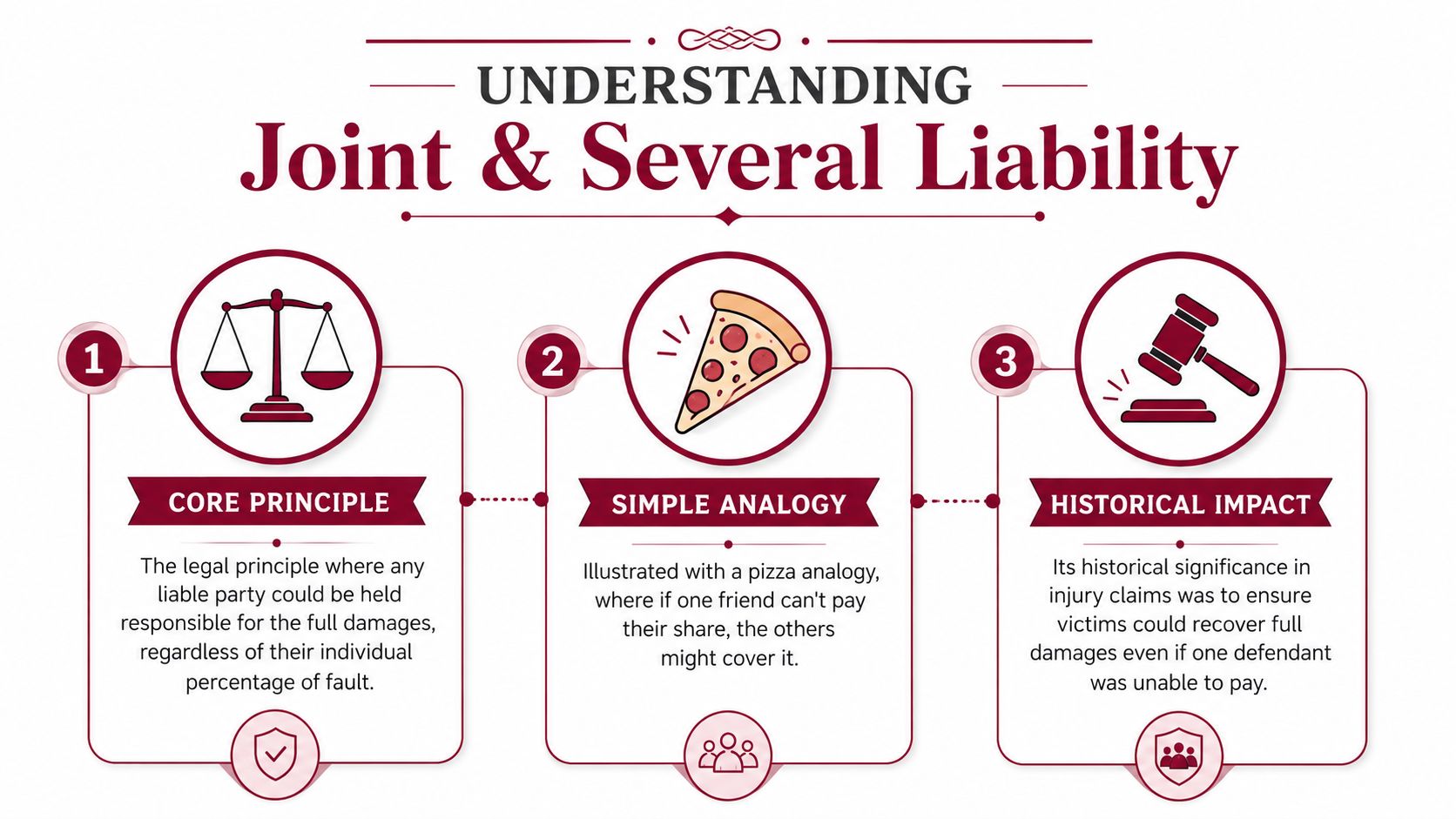
A Simple Way To Understand The Old Rule
A practical comparison is a group dinner bill. Several people order the meal, but the restaurant is still owed one total amount. If one person cannot pay, the restaurant may collect the full bill from someone else at the table who can, and that person can later sort out reimbursement from the others.
That was the basic effect of joint and several liability in injury law. The injured person was not forced to chase each wrongdoer for a separate slice of the recovery. If one defendant had insurance or assets and another did not, the collectability problem fell on the defendants, not on the person who got hurt.
That detail matters more than the definition itself. In real cases, a legal right is only as useful as your ability to collect money at the end.
Why Lawyers And Insurers Cared So Much About It
The rule existed to protect compensation. If several people contributed to one injury, the law prioritized making the injured person whole before sorting out fairness between defendants.
After one defendant paid more than that defendant believed was a fair share, that defendant could try to recover part of the payment from the other responsible parties. Lawyers call that contribution. This discussion of joint and several liability and contribution gives a useful example of how that reimbursement process could work after the plaintiff had already been paid.
For an injured person, that structure changed the settlement conversation. A defendant with strong coverage had a strong reason to resolve the case, even if that defendant argued someone else was more to blame, because that defendant faced real exposure to the full judgment. That pressure often shaped negotiations in a way that improved the plaintiff's chances of recovering the money the case was worth.
What This Means For A Florida Injury Claim
Florida clients still hear this phrase and assume it describes the rule that will control their case today. That is where confusion starts. The historical concept is still important because it explains why older articles, out-of-state examples, and casual advice can give injured people the wrong expectation about who may have to pay and how hard collection may become.
If you are weighing a claim after a collision, the practical question is not just who acted carelessly. It is also whether the available defendants, insurers, and policies create a real path to payment. That is one reason guidance on filing a car accident lawsuit in Florida needs to be based on current Florida rules, not on the older joint and several model.
Practical takeaway: Joint and several liability mattered because it shifted the risk of an uncollectible defendant away from the injured person and onto the people who caused the harm.
Florida's Current Rules on Fault and Financial Recovery
A Florida injury case often turns on a hard money question: if several people helped cause the accident, who can be made to pay, and how much?
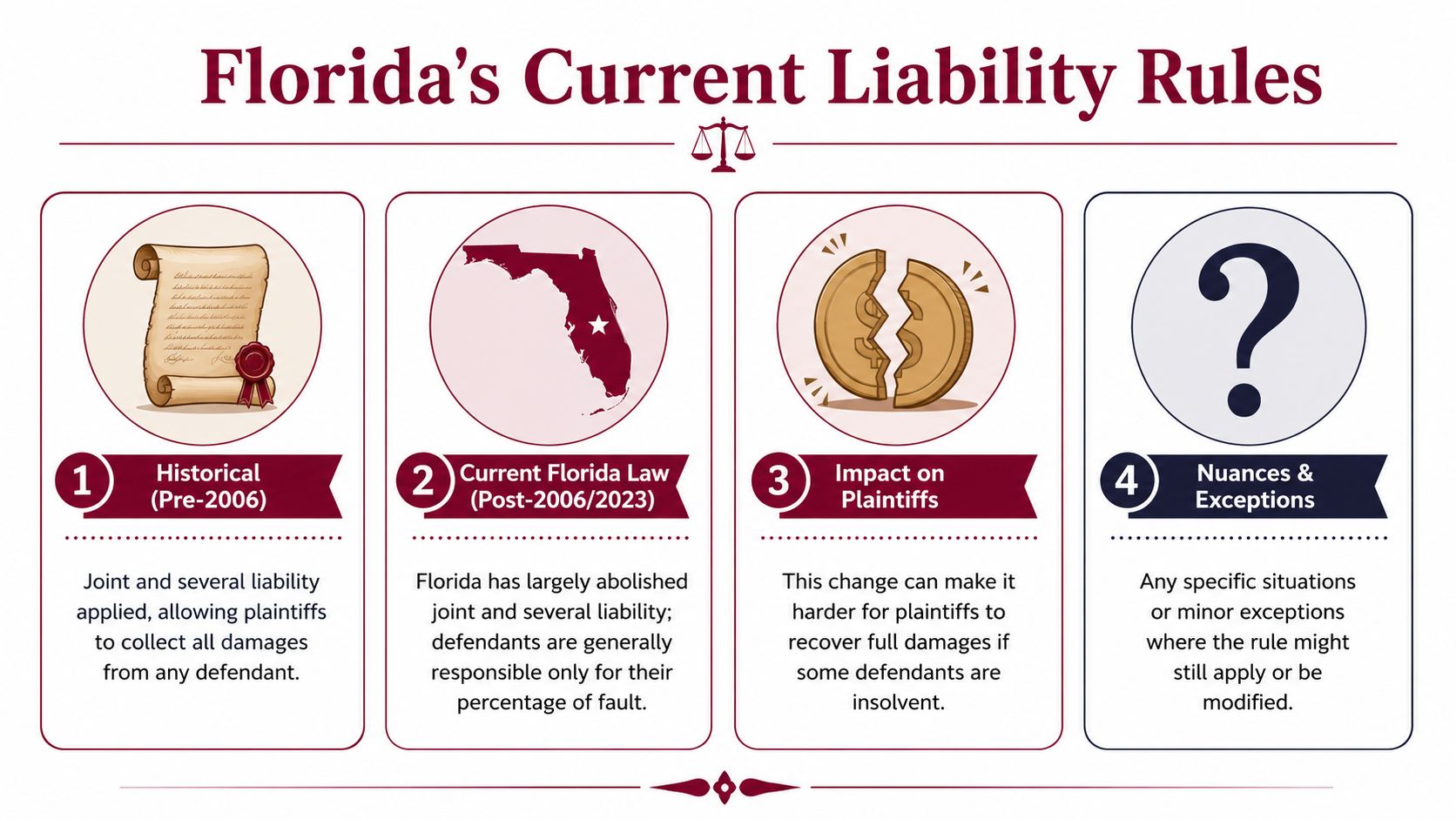
That matters because Florida generally does not use the old rule many people still read about online. Instead, courts usually focus on each party's share of fault. For an injured person, that changes more than legal wording. It changes settlement pressure, insurance strategy, and the odds of collecting the full value of a claim.
The Big Difference From The Old Rule
Under joint and several liability, one responsible defendant could be forced to cover the full judgment, then try to recover part of that payment from others later. It worked like splitting a dinner bill when one person at the table has enough cash and the others do not. The restaurant still gets paid, and the person who covered the bill sorts it out afterward.
Florida negligence cases usually work differently now. Financial responsibility is generally tied to each defendant's percentage of fault. If Driver A is found 70 percent responsible and Driver B is found 30 percent responsible, the injured person usually must collect according to those shares rather than demanding the full unpaid amount from whichever defendant has better insurance.
That sounds technical, but the practical effect is simple. The risk of an underinsured or insolvent defendant often falls more heavily on the injured person.
How That Changes A Claim
In a multi-party case, proving that several people were careless is only part of the job. You also need to build a clear map of fault and a realistic map of payment.
A lawyer may need to answer questions like these:
- Who shares legal responsibility for the crash or dangerous condition?
- What percentage of fault is likely to be assigned to each party?
- Which parties have liability insurance?
- Are there additional sources of recovery, such as a business policy or owner-based liability?
- Is there a gap between the value of the case and the money that is collectible?
Those questions shape settlement talks. A defendant with only a small share of fault may have less reason to pay beyond that share, even if that defendant has strong insurance. On the other hand, finding another responsible party can make a major difference because it may add another policy to the recovery picture.
Why Florida Clients Often Get Confused
Florida drivers also have to deal with the no-fault system at the start of many car accident claims. PIP benefits may cover part of the early medical and wage-loss picture before the bodily injury liability fight is fully developed. If you need background on how those first-party benefits fit into a larger case, our page on Florida no-fault accident claims explains that system in plain language.
That early PIP layer can make people assume the rest of the case will be straightforward. It often is not. Once damages go beyond PIP, the claim can become a careful exercise in proving fault allocation and identifying every usable source of compensation.
Why State-Specific Rules Matter So Much
General articles on joint and several liability often describe a rule that sounds favorable to injured people because it increases the chance of full collection. But those articles may be discussing a different state, a different statute, or an older version of the law. A national chart from White and Williams shows that states handle joint and several liability in very different ways, with many limiting or modifying the rule rather than applying it across all negligence claims, as summarized in this state-by-state overview of joint and several liability rules.
For a Florida client, the takeaway is practical. A case may look strong on paper and still face collection problems if one major wrongdoer lacks coverage and the remaining defendants are responsible only for smaller shares.
The Real Financial Consequence
This is why case value and case collectability are not the same thing.
A strong Florida injury claim needs proof that is precise enough to assign fault persuasively and broad enough to identify every party who may contribute to payment. That can include another driver, an employer, a vehicle owner, a property owner, or a business whose conduct helped create the harm.
The goal is not just to win an argument about blame. The goal is to put together a recovery plan that gives you the best chance of turning a legal right into actual compensation.
How Shared Fault Plays Out In Real Florida Accident Cases
The legal doctrine makes more sense when you see how it affects real claims. The issue isn't just abstract fault. It's who may ultimately pay.
A Pinellas County Style Multi-Vehicle Crash
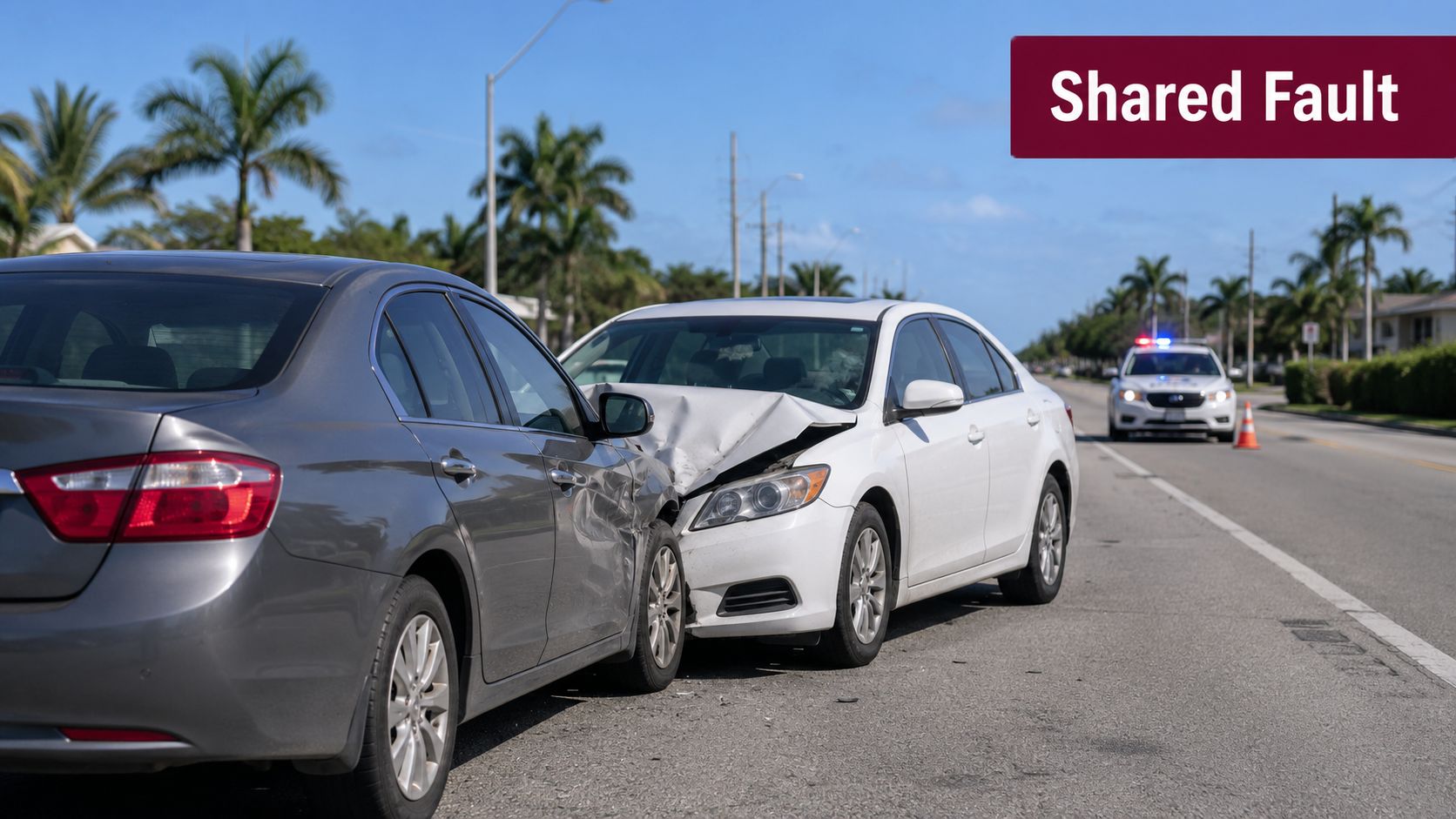
Take a common scenario. You're stopped in traffic. A pickup rear-ends an SUV, and the SUV is pushed into your car. The pickup driver blames the SUV for braking abruptly. The SUV driver says the pickup was distracted. You suffer neck and back injuries, miss work, and need ongoing care.
In a traditional joint and several system, the key question might be whether either defendant can be pursued for the full amount. In Florida, the practical question is usually narrower. What percentage of fault belongs to each actor, and what insurance is available under each policy?
That means your lawyer must gather more than a crash report. The timing of each impact matters. Vehicle damage patterns matter. Witness accounts matter. Phone records, black-box data, body shop evidence, and roadway surveillance may matter too.
A Premises Case With More Than One Responsible Party
Now consider a Florida retail slip-and-fall claim. A customer falls on a wet floor near an entrance. The store blames the janitorial contractor. The contractor says store employees created the hazard by leaving the area unattended after moving carts through rainwater. The injured person has one injury, but there may be more than one negligent party behind it.
That is where older descriptions of joint and several liability can mislead people. They may assume that once two defendants are shown to be careless, collecting the entire judgment becomes easy. In reality, the collection path may depend on how fault is allocated and what contractual or insurance relationships exist among the defendants.
The practical effect of classic joint and several liability was to shift the risk of an insolvent or judgment-proof defendant onto the others. The doctrine was less about equal blame and more about collection certainty for the injured party, as Cornell explains in its overview of joint and several liability.
Why Identifying Every Responsible Party Matters
In Florida, missing one liable party can reduce the money available to you. That's true in vehicle cases and in premises claims.
A careful lawyer will often look beyond the obvious defendant and ask:
- Was there an employer relationship: If a driver was working at the time, a company may be relevant.
- Was a vehicle owner separate from the driver: Ownership and permissive use issues may affect available coverage.
- Did a contractor create or ignore a hazard: Stores, landlords, maintenance vendors, and property managers may all become important.
If you want to see how crash value can depend on the details, motorcycle crash settlement examples show why facts, evidence, and insurance structure matter so much.
The takeaway is simple. In Florida, shared-fault cases are often won or lost in the investigation stage. If fault gets spread to someone who can't pay, or if a responsible party is never identified, the injured person may bear that loss in a way that a classic joint and several system would have avoided.
Common Misconceptions About Multi-Party Injury Claims
People usually come into these cases with half-remembered advice from friends, insurance adjusters, or internet searches. Some of that advice is flatly wrong.
Myth One You Can Always Collect Everything From One Defendant
That's the classic idea behind joint and several liability. It's also why many people search what is joint and several liability after a serious accident. But Florida negligence claims generally don't work that way now. You usually need to prove fault carefully and pursue recovery based on the applicable Florida framework, not on the older all-from-one model.
If one defendant has weak coverage, that can become a real collection problem rather than something you can shift to a better-funded defendant.
Myth Two Shared Fault Rules Work The Same Everywhere
They don't. States take different approaches.
California is a good example of how much variation exists. Its system limits joint-and-several exposure for non-economic damages when a defendant is found less than 50% at fault, while allowing broader joint liability for defendants at 50% or more at fault, as described in ALEC's discussion of state approaches and the California threshold model. The same accident facts can produce very different collection outcomes depending on the state.
Myth Three If You Were Partly At Fault, Your Case Is Over
That's a dangerous assumption. In Florida, a partial-fault argument from the other side doesn't automatically end your claim. It does mean fault allocation becomes important, because every percentage point can affect what you recover.
That's one reason recorded statements and early insurer communications can matter so much. A casual comment can become a blame-shifting tool later.
Myth Four The Insurance Companies Will Identify Every Responsible Party For You
Usually, they won't. Each insurer has its own interests.
A carrier may focus narrowly on minimizing its insured's role. Another may try to place blame on an absent party, an unknown driver, a contractor, or even on you. In multi-party cases, no one on the defense side is responsible for building the best version of your case.
Don't assume a complicated claim becomes easier because more defendants are involved. Sometimes it becomes harder because each one points at somebody else.
Navigating Complex Liability Claims With Haddad & Associates
A multi-party injury case can feel like several people handing you pieces of the same bill while each one insists someone else should pay it. In Florida, that fight is not just about blame. It affects where compensation may come from, how insurers evaluate the case, and whether a settlement offer reflects the money that is realistically available.

What A Lawyer Actually Does In These Cases
Early legal work often shapes the outcome. Before serious settlement discussions begin, someone has to identify every person or business that may share responsibility, secure records before they disappear, preserve photos and vehicle data, and challenge the early version of events being pushed by insurers.
That matters because a case is only as useful as its path to payment. If one defendant has limited coverage, but another company or policy was missed at the start, the injured person may end up with a paper claim that looks stronger than it collects.
A lawyer handling this kind of case may:
- Identify every responsible party: drivers, vehicle owners, employers, contractors, property managers, maintenance companies, and others whose conduct may have contributed
- Build the fault story with evidence: crash reports, witness statements, medical records, scene evidence, company documents, and expert review when needed
- Focus on collectability: insurance policies, business assets, coverage disputes, and the practical sources of compensation
- Push back on blame shifting: especially when each insurer tries to shrink its own insured's role
Joint and several liability used to matter so much because it could change who had to pay when one wrongdoer could not. Florida's current system requires a different approach. Your lawyer has to examine fault and insurance at the same time, because those two issues now work together to shape settlement value.
Why Investigation Affects The Money Side Of The Case
In Florida, small changes in fault allocation can have a large financial effect. If the defense adds more blame to you, your recovery can drop. If the evidence shows another driver, company, or property owner played a larger role, the claim may reach more insurance coverage or a better-funded defendant.
That is why early investigation often matters most in cases like these:
- Commercial vehicle crashes, where driver logs, hiring records, maintenance files, and company policies may point beyond the individual driver.
- Premises liability claims, where inspection records, cleaning schedules, repair histories, and vendor contracts can show who had responsibility for safety.
- Chain-reaction collisions, where the order of impacts can affect both fault and which insurance carriers should contribute.
For many injured people, what a personal injury lawyer can do for you comes down to protecting evidence, identifying every available source of compensation, and keeping the case from being narrowed too early by an insurer's version of the facts.
One Florida option for this kind of case is Haddad & Associates P.A., a Clearwater personal injury firm that handles accident and negligence claims involving disputed fault and insurance issues.
Frequently Asked Questions About Joint Liability In Florida
What happens if one at-fault driver is uninsured or underinsured in Florida
That can make recovery more difficult because Florida generally doesn't let you shift that unpaid share to another minimally responsible defendant the way a traditional joint and several system might. In many cases, uninsured or underinsured motorist coverage becomes important. The exact answer depends on the available policies, the number of responsible parties, and how fault is assigned.
Can I still bring a claim if I may have been partly at fault
Yes, partial fault doesn't automatically mean you have no case. It does mean the defense will likely try to increase your share of blame to reduce what they have to pay. That's why the facts, witness statements, vehicle damage, medical records, and timing of treatment matter so much.
Does fault allocation affect my medical bills while the case is pending
Usually, fault allocation affects final recovery more than immediate treatment access. While the case is ongoing, people often rely on available insurance benefits, health insurance, letters of protection, or other payment arrangements depending on the type of accident. The legal fight over fault often takes much longer than the need to get medical care.
Does this concept apply only to car accidents
No. The same general issue can appear in truck crashes, slip-and-fall cases, negligent security claims, product-related injuries, and other cases where more than one party may have contributed to the same harm.
If you were hurt in a Florida accident and more than one person or business may be responsible, a lawyer can help sort out fault, identify all available insurance, and build a case around actual recovery instead of guesswork. Haddad & Associates P.A. offers free consultations for injured people in Clearwater, Pinellas, Hillsborough, and surrounding Tampa Bay communities.